
Parking Garage Ventilation Systems: Importance, Types, and Design Standards
Ventilation systems in underground and enclosed parking garages are essential for maintaining air quality and ensuring safety. Due to the accumulation of harmful gases like carbon monoxide (CO) from vehicle exhausts, proper air circulation becomes vital. This article explores the importance of parking garage ventilation, its types, key design considerations, and modern intelligent systems.
Why Is Ventilation Necessary in Parking Garages?
The primary purpose of a ventilation system in parking structures is to expel pollutants, control temperature, and ensure sufficient oxygen levels. The most critical pollutant is carbon monoxide (CO), a colorless and odorless gas that can accumulate rapidly in closed environments. Exposure to high levels of CO can cause nausea, fatigue, and even death. Hence, compliance with ventilation standards is not just regulatory—it’s a matter of public safety.
Types of Parking Garage Ventilation Systems
1. Natural Ventilation
This system relies on the physical design of the structure to enable air movement. Openings on opposite walls or ceilings allow for cross-ventilation using natural wind and pressure differences.
- Advantages: Cost-effective, energy-efficient, simple design.
- Limitations: Less effective in deeper or fully enclosed garages where natural airflow is restricted.
2. Mechanical Ventilation
Mechanical systems use fans and ductwork to force air movement and ensure pollutant removal. These systems are more common in large, underground, or fully enclosed parking structures.
- Advantages: Controlled airflow, consistent performance, effective in any structure.
- Limitations: Higher initial and maintenance costs, energy consumption.
3. Hybrid or Mixed-Mode Systems
Combining both natural and mechanical methods, hybrid systems use natural ventilation during favorable conditions and activate mechanical systems when air quality drops.
- Advantages: Energy savings, adaptability.
- Use Cases: Ideal for regions with variable weather or structures that partially open to the outside.

Key Components of a Mechanical Ventilation System
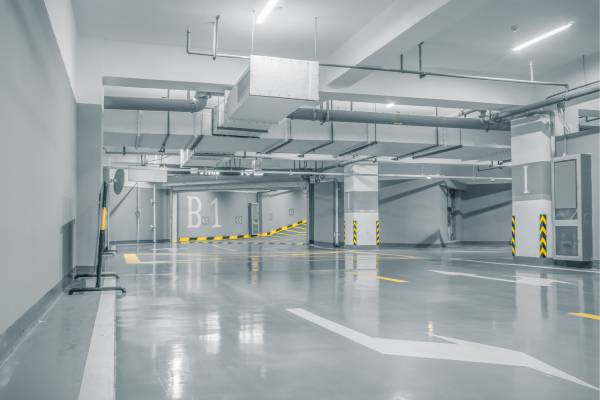
- Jet Fans or Impulse Fans: Direct airflow toward exhaust points.
- CO Sensors: Detect carbon monoxide levels and control fan operation.
- Exhaust and Supply Fans: Facilitate the removal of polluted air and introduction of fresh air.
- Control Panels: Manage fan speed and activation based on sensor input.
Design Considerations and Standards
Ventilation design must adhere to international and local building codes, such as ASHRAE and NFPA standards. Key factors include:
- Air Change Rate: Minimum air exchanges per hour depending on garage size and use.
- CO Level Thresholds: Fans should activate when CO levels reach 25–50 ppm.
- Fire Safety Integration: Fans should operate during fires to clear smoke and aid evacuation.
- System Redundancy: Backup systems to ensure functionality during power loss.

Smart Ventilation Systems
With advances in technology, modern systems include automation and remote monitoring capabilities. Smart ventilation uses AI and IoT sensors to:
- Monitor CO and NOx levels in real time.
- Adjust fan operation dynamically to reduce energy consumption.
- Alert facility managers to maintenance needs or abnormal gas concentrations.
Conclusion
Proper ventilation in parking garages is more than a technical requirement—it is a critical safety and health measure. Whether through natural, mechanical, or hybrid systems, the goal is to ensure air quality, protect lives, and comply with regulations. With the integration of smart technology, modern ventilation systems now offer increased efficiency, safety, and environmental benefits.